
Telangana, India’s youngest state formed in 2014, has rapidly transformed into an economic powerhouse in less than a decade. With Hyderabad as its capital, the state has leveraged its strategic location, robust infrastructure, and innovation-driven industries to climb the ladder of progress. From strong GDP growth and booming exports to massive investments in pharmaceuticals and data centers, Telangana’s story is one of ambition, vision, and smart governance. This article explores the key aspects behind Telangana’s dynamic economic trajectory in 2026 breaking down its growth across sectors, initiatives, and future projections.
Telangana’s GSDP and Sectoral Growth:
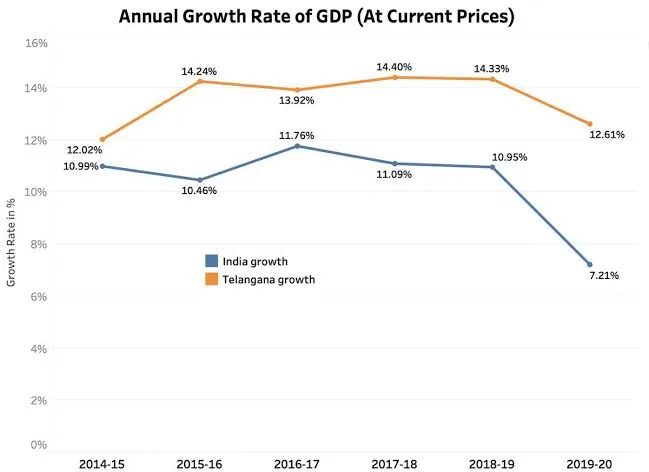
The Gross State Domestic Product (GSDP) of Telangana reflects its aggressive growth strategy. At current prices, it stood at ₹18.0 trillion (US$ 209.10 billion) for FY26BE, growing at a CAGR of 11.13% between FY19 and FY26BE.
Key Insights:
- Tertiary Sector: Recorded a CAGR of 14.18% from 2011-12 to 2022-23, driven by IT, financial services, and healthcare.
- Primary Sector: Achieved a strong CAGR of 12.51%, supported by irrigation expansion and agri-reforms.
- Exports: Touched ₹1.49 lakh crore (US$ 17.39 billion) in FY25 (till February), led by pharmaceuticals, chemicals, and electronics.
Telangana’s balanced investment across sectors shows its focus on both urban innovation and rural resilience.
Hyderabad’s Role in Data and Digital Infrastructure:
Hyderabad is not just the state capital,.it’s Telangana’s tech and data nucleus. With major investments in data centers, cloud technology, and IT infrastructure, Hyderabad is set to become a global digital hub.
Notable Developments:
- AWS Investment: Amazon Web Services is investing US$ 2.8 billion in a new core data center.
- NPCI Expansion: National Payments Corporation of India committed US$ 70 million for a Tier-IV data center.
- Microsoft: Announced a ₹15,000 crore (US$ 1.93 billion) plan to build its largest Indian data center in Hyderabad.
These projects signal Telangana’s transition from a service economy to a digitally empowered innovation engine.
Hyderabad’s Emerging Role as a Global Investment Magnet:
Hyderabad is no longer just a regional business center, it has become a global magnet for investment, thanks to its balanced ecosystem of innovation, infrastructure, and investor-friendly policies. The city’s rise is not accidental but the result of long-term strategic planning and sector-specific incentives.
Here are 6 key reasons why Hyderabad is attracting global investors:
- Diverse Industrial Base: From pharmaceuticals and life sciences to IT, aerospace, and electronic manufacturing, Hyderabad offers opportunities across a wide industrial spectrum, making it appealing for both legacy companies and emerging startups.
- World-Class Infrastructure: With projects like the Hyderabad Pharma City, Genome Valley, and seamless metro and road connectivity, investors are assured of logistics, power, and mobility to scale operations efficiently.
- Stable Governance and Policy Support: The Telangana government has introduced several ease-of-doing-business reforms, including TS-iPASS, a single-window clearance system that guarantees approvals within 15 days.
- Affordable Talent Pool: Hyderabad boasts a young, skilled workforce that is not only cost-effective but also aligned with the technological and manufacturing needs of global firms.
- Global Company Presence: Giants like Amazon, Microsoft, Facebook, and Novartis have already established large-scale campuses, validating the city’s global standing and attracting more investors.
- Low Operational Costs: Compared to cities like Bengaluru or Mumbai, Hyderabad offers lower real estate prices and operational overheads, making it highly cost-competitive for long-term investments.
This combination of advantages has made Hyderabad a serious contender on the global investment map, poised to play an even bigger role in India’s economic future.
Foreign Direct Investment and Telecom Connectivity:
Foreign capital continues to recognize Telangana’s potential. Between October 2019 and December 2024, FDI inflows reached ₹78,203 crore (US$ 9.84 billion). Hyderabad’s investor-friendly policies, coupled with a young and skilled workforce, make it a preferred destination.
On the connectivity front:
- Wireless Subscribers: 82.5 million
- Wireline Subscribers: 4.17 million
- Teledensity: 94.31% as of December 2024
Such numbers demonstrate the state’s growing digital inclusivity and readiness for further tech-driven development.
Sectoral Push: Power, Irrigation, and Urban Transformation
Telangana’s infrastructure initiatives go beyond just urban centers. Rural Telangana is also benefiting from investments in power, water, and transport.
Highlights:
- Power Capacity: Total installed capacity reached 20,403 MW in March 2025, with 12,492 MW from thermal sources and 5,283 MW from renewables.
- Irrigation Drive: The state aims to bring an additional 50 lakh acres under irrigation to complement the 73 lakh acres irrigated in 2023.
- Urban Budgeting: ₹2,654 crore was allocated to GHMC for modern infrastructure in Hyderabad city.
These efforts underline Telangana’s commitment to inclusive and sustainable growth.
Public-Private Partnerships Fueling Infrastructure Growth:
Telangana’s rapid economic development owes much to its proactive embrace of Public-Private Partnerships (PPPs) across infrastructure projects. By collaborating with private players in transportation, urban development, healthcare, and industrial parks, the government has been able to accelerate timelines and ensure efficiency. Projects such as the Hyderabad Pharma City, the Hyderabad Metro Rail, and the state’s expansive irrigation schemes highlight the effectiveness of these joint ventures.
These partnerships not only reduce the financial burden on the state exchequer but also bring global expertise into local projects. Investors are drawn to Telangana because of its transparent tender processes and predictable policy environment, further reinforcing the state’s reputation as a business-friendly destination. As Telangana continues to urbanize and industrialize, PPPs will play a central role in ensuring that growth is both inclusive and sustainable.
Rise of the Pharma and Life Sciences Industry:
Telangana has rapidly become the pharmaceutical capital of India. The state has made targeted investments and formed global partnerships to boost life sciences and biotech sectors.
Key Growth Indicators:
- Pharma Exports: Reached US$ 4.66 billion in FY22, accounting for nearly 20% of India’s total pharma exports.
- Hyderabad Pharma City: A smart industrial city that aims to generate US$ 100 billion by 2030.
- Recent Investments:
- Ferring Pharmaceuticals invested €30 million (US$ 31.3 million).
- Granules India to invest ₹400 crore in a greenfield formulation facility.
- ₹7,500 crore invested in pharma, biotech, and medical devices sectors over the past year.
This focus on health sciences positions Telangana as a global player in medical innovation and manufacturing.
Tourism, SEZs, and Agricultural Growth:
While known for its industrial growth, Telangana has also seen success in tourism, agriculture, and special economic zones (SEZs).
Noteworthy Points:
- Tourism: 60.8 million domestic and 0.684 million foreign tourists visited the state in 2022.
- SEZ Expansion: 35 operational SEZs, with 57 notified and 64 formally approved as of July 2022.
- Agricultural Output: Fruits and vegetables reached 1.87 million tonnes and 1.07 thousand tonnes respectively in 2023-24.
By nurturing these sectors, Telangana has diversified its economic portfolio beyond just industry and tech.
Flagship Government Schemes and Budget Priorities:
Telangana’s government has made smart allocations to ensure growth is both people-centric and future-ready.
Key Allocations in FY26 Budget:
- Rythu Bharosa Scheme: ₹18,000 crore allocated to support farmers.
- Primary & Secondary Education: ₹12,601 crore earmarked.
- GHMC Infrastructure Development: ₹2,654 crore set aside.
- Healthcare Support via Aarogyasri: ₹1,034 crore assigned for the health care trust.
These investments show that Telangana’s development is not just economic, it’s deeply rooted in social welfare.
Focus on Skill Development and Youth Empowerment:
Recognizing that economic growth must be inclusive, Telangana has placed significant emphasis on skill development and youth empowerment. Through programs like TASK (Telangana Academy for Skill and Knowledge), the government has bridged the gap between academic institutions and industry demands. Thousands of students are being trained annually in digital literacy, communication, data science, cloud computing, and other industry-relevant skills.
Additionally, the state’s support for startups through T-Hub and WE-Hub has empowered young entrepreneurs and fostered innovation across sectors. By investing in human capital, Telangana is not just preparing its youth for jobs, it’s enabling them to create them. These initiatives are crucial to maintaining the state’s competitive edge in a knowledge-based economy and ensuring long-term socio-economic stability.
Conclusion:
Telangana’s meteoric rise since 2014 is not just the result of economic policies, it’s a story of political will, technological foresight, and a commitment to inclusive development. From a powerhouse of pharmaceutical exports to a leading digital infrastructure hub, the state continues to redefine what modern India can look like. Its balanced growth across urban and rural landscapes, its focus on sustainability, and the smart use of both domestic and foreign investments make it a role model for other states to follow. As we step into 2026, Telangana isn’t just catching up, it’s setting the pace.
FAQs:
As of FY26BE, Telangana’s GSDP stands at ₹18.0 trillion (US$ 209.10 billion), growing at a CAGR of 11.13% since FY19. The tertiary and primary sectors have been key drivers.
Hyderabad serves as the state’s economic engine, with major data centers, pharma hubs, IT parks, and global investments, making it a focal point for both domestic and international growth.
The primary exports include pharmaceutical products, biologicals, electronic goods, and chemicals. Pharma alone contributed US$ 4.66 billion in FY22.
Through schemes like Rythu Bharosa (₹18,000 crore), irrigation expansion, and agricultural subsidies via state discoms, the government is heavily investing in rural upliftment.
With investor-friendly policies, excellent digital and physical infrastructure, and a skilled workforce, Telangana has attracted nearly US$ 9.84 billion in FDI between 2019 and 2024.