
In a fiery political development, BRS working president K.T. Rama Rao (KTR) has publicly accused Congress leaders of grabbing residential plots allocated to farmers displaced by the Hyderabad Pharma City project. These plots were part of a structured compensation package, but KTR alleges they are now being forcibly registered in the names of Congress leaders at unfairly low prices. His sharp criticism of the Congress government, particularly targeting Chief Minister Revanth Reddy, comes as a defense of the very farmers who gave up their lands for Telangana’s industrial vision.
The controversy not only highlights deep-rooted political tensions but also puts a spotlight on the government’s failure to fulfill election promises made to vulnerable communities. As the accusations unfold, the issue is fast becoming a test of transparency and accountability in Telangana’s governance.
KTR’s Accusations: Betrayal of Farmer Trust
K.T. Rama Rao didn’t hold back as he accused the Congress government of betraying the farmers who gave their lands for Hyderabad’s Pharma City. He claimed that Chief Minister Revanth Reddy had promised to cancel the Pharma City project and return lands to the farmers if voted into power. However, 18 months later, the plots remain undelivered, and worse, are allegedly being usurped by Congress leaders.
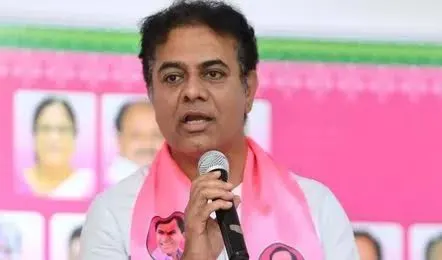
Key concerns raised by KTR include:
- The delay in distributing compensatory plots despite finalized layouts.
- Congress leaders registering the plots under their names.
- Forced purchases from farmers at only ₹4,000–₹5,000 per sq yard, while market rates are at ₹30,000.
- A planned 330-foot greenfield road running through the layout an alleged move to devalue farmer plots.
This, he asserted, was not just incompetence but deliberate exploitation of those who made sacrifices for the state’s growth.
Farmers’ Compensation and What Was Promised ?
Under the BRS government, over 19,400 acres were acquired from farmers in Maheshwaram and Ibrahimpatnam constituencies. The compensation package included:
- ₹16.5 lakh per acre for patta land.
- ₹8.5 lakh per acre for assigned land.
- 121 sq yards of residential land per acre surrendered.
To ensure rehabilitation, 1,400 acres in Mir Khanpet (Kandukur Mandal) were allocated, with a planned layout over 560 acres. These plots were meant to be a secure future for displaced families most of whom depended on farming for their livelihood.
However, after the election win by Congress, this process reportedly stalled. The land was never officially handed over to beneficiaries, allowing others to take advantage of the situation.
How Alleged Land Grabs Took Place?
KTR alleged a carefully planned manipulation by Congress leaders:
- Deliberate delay in land distribution created uncertainty among farmers.
- Political influence was used to access internal layouts and information.
- Vulnerable farmers, unaware of legalities and desperate for cash, were coerced into selling.
- Underpriced deals took advantage of farmers’ lack of market access or legal aid.
This scheme, KTR argued, shows how easily good intentions can be turned into exploitation when governance lacks integrity and transparency. The act, he said, is nothing short of “looting in broad daylight.”
Political Promises vs. Ground Reality:
Revanth Reddy, before coming to power, made headlines by promising to return the land acquired for Pharma City. It became a core election pitch, portraying the Congress as farmer-friendly. However, KTR now claims those promises were hollow.
Points of contradiction include:
- No cancellation of the Pharma City project.
- No land return despite prior assurances.
- No transparency on the resettlement progress.
- Alleged misuse of power by Congress leaders to acquire land meant for farmers.
These broken promises have not only stirred political outrage but have also triggered disillusionment among farming communities who now feel abandoned by both parties.
What KTR Demands Now?
KTR has made clear, actionable demands to the Congress government:
- Immediate cancellation of all illegal registrations of plots.
- Public disclosure of all current plot ownership in Mir Khanpet layout.
- Strict action against leaders found guilty of coercion or manipulation.
- Restoration of rightful plots to every displaced farmer.
He warned that silence from the government would only confirm the allegations. KTR also hinted at legal and political pressure if corrective steps were not taken swiftly.
Silence from Congress Leaders Raises Further Questions:
One of the most striking aspects of this controversy is the complete silence from key Congress leaders, especially those named or hinted at in KTR’s allegations. While the accusations are serious ranging from coercion to illegal land registration there has been no detailed clarification, denial, or counter from the Congress camp. For many, this lack of response appears to confirm the suspicions rather than dispel them.
Political analysts point out that in a situation involving compensation for displaced farmers who are already emotionally and financially strained, a prompt response from the ruling party is crucial. The absence of such engagement signals either administrative negligence or deliberate avoidance. Some speculate that the Congress government may be internally conflicted about how to handle the situation, given the involvement of local leaders at the ground level. Others believe the silence is a strategy to buy time, suppress media coverage, or wait out the storm. Whatever the case may be, it has allowed KTR to dominate the narrative, further fueling public distrust in the state’s handling of the Pharma City compensation promises.
Public Sentiment and Farmer Backlash Growing:
While this might seem like just another political slugfest, the impact on public sentiment especially among farmers is growing more visible. The people who were promised a share in Telangana’s industrial future now feel cheated and abandoned. In villages around Maheshwaram and Ibrahimpatnam, murmurs of betrayal have turned into loud discontent. Farmers say they gave up land not for profit, but for progress believing in a shared vision that now feels hijacked.
The emotional toll is significant. Many land oustees had already moved on from agriculture, counting on the compensatory plots for housing or financial security. Now, seeing their promised land being registered under others’ names feels like a second displacement. Small-scale protests have begun, and village elders are calling for all-party interventions to resolve the issue before it spirals. Local youth, once hopeful about jobs and growth from Pharma City, now express cynicism toward both BRS and Congress, fearing political deals will always override justice. In essence, the backlash is real and if left unaddressed, could reshape future electoral landscapes in Telangana.
Conclusion:
This issue extends beyond politics at its heart are farmers who parted with their ancestral land for the promise of a better future. Now, that promise appears shattered. KTR’s strong allegations may be politically charged, but they also draw attention to the real-world consequences of broken systems and unkept promises.
As Telangana continues its path toward industrialization, this incident serves as a reminder: development should never come at the cost of dignity and justice for the very people it claims to uplift.
FAQs:
The Hyderabad Pharma City is a large-scale industrial zone for pharmaceutical manufacturing, initiated to boost economic growth and job creation in Telangana.
Farmers were paid ₹16.5 lakh per acre for patta land and ₹8.5 lakh per acre for assigned land, plus 121 sq yard plots per acre.
KTR alleges that Congress leaders are forcibly registering plots meant for farmers in their names, exploiting the delay in distribution.
He demands cancellation of illegal plot registrations and immediate restoration of ownership to the original farmer beneficiaries.
As of now, there has been no detailed rebuttal or official statement from the Congress government addressing these specific allegations.